


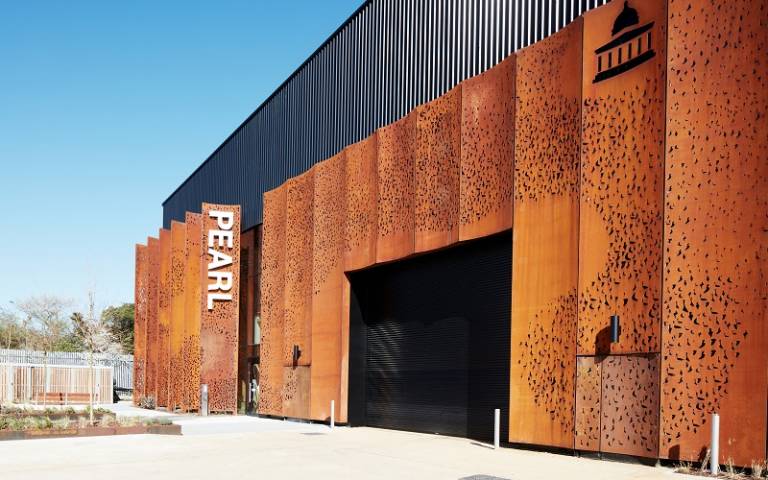
PEARL is a massive space in which life-sized environments are created to examine how people interact with their environment. It spans across 4,000m2 in which real-life situations can be recreated; a busy high street, a town square or a rail station. Soundscapes can be created, as can the lighting conditions at different times of day; even weather conditions and smells can be replicated in this facility. Ground conditions can be changed to mimic carriageway, a pavement, even hills.
We were given a sneak-peak of the facility by Professor Nick Tyler, where we were shown some of the interesting work underway.
“In order to understand possible solutions for our public space, we first need to understand human behaviour better,“ Professor Tyler said.
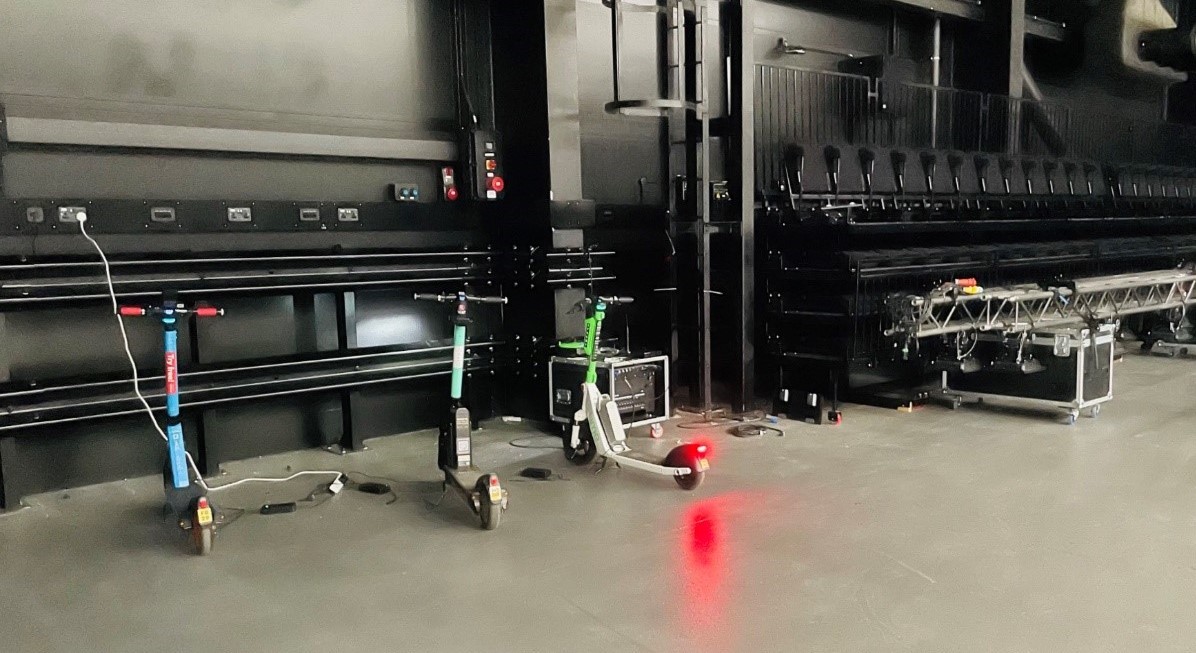
E-scooters experiment
One of the interesting projects being undertaken relates to the reaction of humans to e-scooters; how we perceive an e-scooters’ arrival, how quickly we react to it, what senses we utilise to lead this reaction, and what is the effect of the different environmental conditions on this reaction. In this exercise, Professor Tyler tries to design parameters that will lead to humans being able to perceive the arrival of the e-scooter, but not react to it.
We all have experienced situations in which we jump when we realise something unexpected is suddenly behind us. The same happens with electric cars. We perceive electric cars as being quieter than petrol cars due to the different frequencies their sound emits and the fact that humans perceive it differently than petrol cars, especially when background noise is present. The problem is that when people startle, they can act erratically, including stepping into the path of the oncoming vehicle by mistake.
For this reason, the EU introduced new rules in 2019 on noise emitting to protect vulnerable users, which means that electric/hybrid cars are required to “fake” a sound. Sound generation is required from the start of the car up to the speed of approximately 20km/h. Hollywood music composer Hans Zimmer was recently instructed by BMW to design a sound for their new electric car.
That is where PEARL’s work is required to test real life situations. His work explores the exact pitch and tone needed to be heard in a busy urban environment that allows a person to reasonably predict where the vehicle is in relation to themselves, how fast it is approaching, and importantly, a tone that doesn’t startle them.
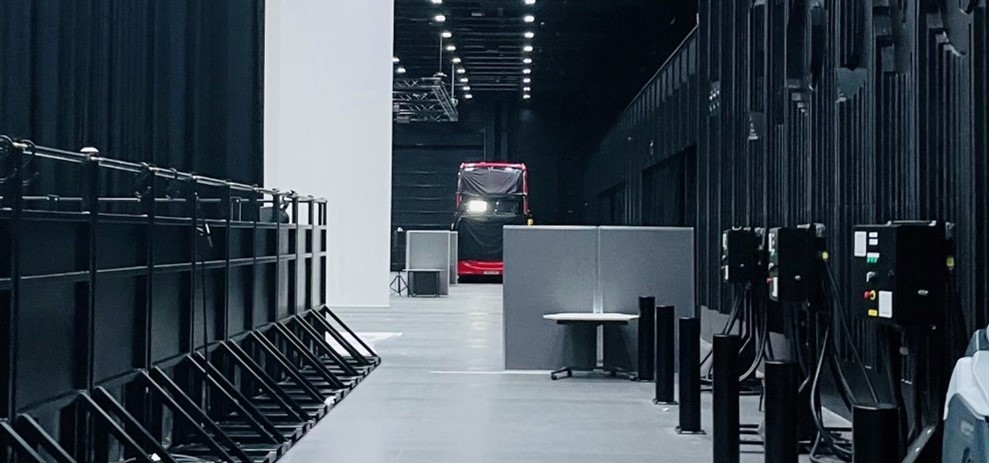
Legibility of digital signs for TfL
TfL is looking to introduce digital signs in their buses, but they are worried about their legibility. Professor Nick Tyler and his PHD students are currently simulating the digital pillars and their legibility under different conditions; how far can a human see the digital signs from on average and under what conditions can they see them. Are there conditions (e.g. fog) that lead rapidly to a drop of the legibility of the pillars? What can be done in the signs to improve their legibility? What is the appropriate resolution of the signs?
The kinds of work being undertaken at PEARL reinforced my aspirations on what we, as transport professionals need to achieve when designing public space. The three aspirations that come out of it are the following:
- It is important that we, as transport planners, consider all users, with their distinct characteristics and sensitivities. We need to consider people with different sensory sensitivities, different age groups, and vulnerable people.
- We need to be creative in the way we think about the public space. In order to account for the diversity of users anticipated to use the public space, we need to try and put ourselves in different situations and conditions. This is one of the aspects PEARL help us with.
- We need to be aware of the benefits that ongoing research brings to us. The private sector needs to work closer together with research institutions to ensure that research findings provide benefits as soon as possible to the way we design and think about public space.
But are we as transport professionals in touch with the advances happening around us? What is required to bring transportation professionals closer to the research and technological advances as well as the benefits this could bring to us?
Due to the increasing demands of our profession, there is a greater need to develop new capabilities and improve the way we design and think. There is an increasing need for transportation professionals to collaborate with educational and research institutions to develop new facilities and tools which help us design sustainable and inclusive public space and allow for a cross-disciplinary approach. Transportation professionals should utilise technological advances to understand different groups of users and the ramifications of designers’ choices on these groups. Traffic and pedestrian environment simulations can help us achieve that and should work hand in hand with research that is undertaken at PEARL and other research institutions to further develop our understanding of ourselves, humans, with all our diversity.
By Panos Floros
